
About Us
We combine decades of courtroom experience with a client-first approach to deliver clear, effective legal solutions.
Please fill out the form below and we will get back to you as soon as possible.
We combine decades of courtroom experience with a client-first approach to deliver clear, effective legal solutions.
You have separated, the household budget is now yours alone, and the practical question is where to file. A section 144 BNSS maintenance application before a magistrate is the route that replaced Section 125 of the Code of Criminal Procedure, 1973, and for many wives it produces a monthly order faster and at far lower cost than a contested family court petition. It is also narrower: it gives monthly support, not a lump sum. Choosing between the two, or running both without recovering the same money twice, is the real decision.
Section 144(1) of the Bharatiya Nagarik Suraksha Sanhita, 2023 empowers a Judicial Magistrate of the First Class to order a person with sufficient means to pay a monthly allowance to a wife who is unable to maintain herself, to his minor children whether legitimate or illegitimate, to a child above eighteen who cannot maintain himself because of physical or mental abnormality, and to his father or mother. Religion makes no difference to eligibility. The proceeding sits inside a criminal statute but is quasi-criminal in nature; the husband is not being prosecuted for an offence.
Three statutory details decide most cases at the gate. The Explanation to the section treats a divorced woman who has not remarried as a wife, so a decree of divorce does not shut this remedy. Sub-section (4) sets out the defences: the wife is living in adultery, she refuses to live with him without sufficient reason, or the parties are living separately by mutual consent. The proviso then removes the ground from under the second defence where the husband has married again or keeps a mistress, since that is itself a just ground for her to refuse to live with him.
Sufficient means is not confined to a salary slip. A husband who has taken early retirement, works abroad, runs a business with thin books or holds property while showing modest income remains within the section, because the enquiry is into his capacity and standard of living, not only his taxable salary.
The magistrate is running a maintenance court. It answers one question: how much per month, and from when. It will not dissolve the marriage, divide property or award a one-time settlement.
| Point | Magistrate under Section 144 BNSS | Family court under the Hindu Marriage Act, 1955 |
|---|---|---|
| Relief available | Monthly maintenance and litigation expenses, plus interim relief while the case runs | Interim maintenance under Section 24; permanent alimony under Section 25, as a lump sum or a monthly sum |
| Security for payment | Personal liability, backed by warrant and imprisonment | Payment under Section 25 can be secured by a charge on the husband's movable or immovable property |
| Court fee | None | As prescribed by the state's rules |
| Challenge to the order | Ordinarily by revision before the Sessions Court or the High Court | By appeal under the Act |
The charging power under Section 25 is the strongest single reason a wife whose husband owns a flat or agricultural land prefers the family court, or wants both proceedings alive. A monthly order that survives only as long as the husband chooses to pay is worth less than one secured on an asset. Conversely, a wife whose husband is salaried, mobile and unlikely to transfer property gains more from the magistrate's power to issue a warrant than from a charge she may never enforce.
Section 145 BNSS, the procedural section that follows Section 144, keeps the old rule on forum. The case may be filed where the husband resides, where he last resided with his wife, or where he is employed or ordinarily resides. That choice matters. If he works in Bengaluru while she lives with her parents in Thrissur, the Thrissur magistrate has jurisdiction only if it is also a place where he last resided with her or where he otherwise resides or is employed. Filing in the wrong district means the case is returned and months are lost.
The application is an affidavit-backed petition, not a plaint. Set out the marriage, the date of separation, the children, his income and assets as known to you, your own income, your monthly needs, and the prayer for interim and final maintenance. Attach the marriage proof, evidence of the separation, his salary slips or Form 16 or income tax return if you have them, bank statements showing transfers, school fee receipts and medical bills. Since 2021 the Supreme Court's guidelines require both spouses to file an affidavit of assets and liabilities; a wife who hides a fixed deposit or rental income loses credibility on the husband's income too.
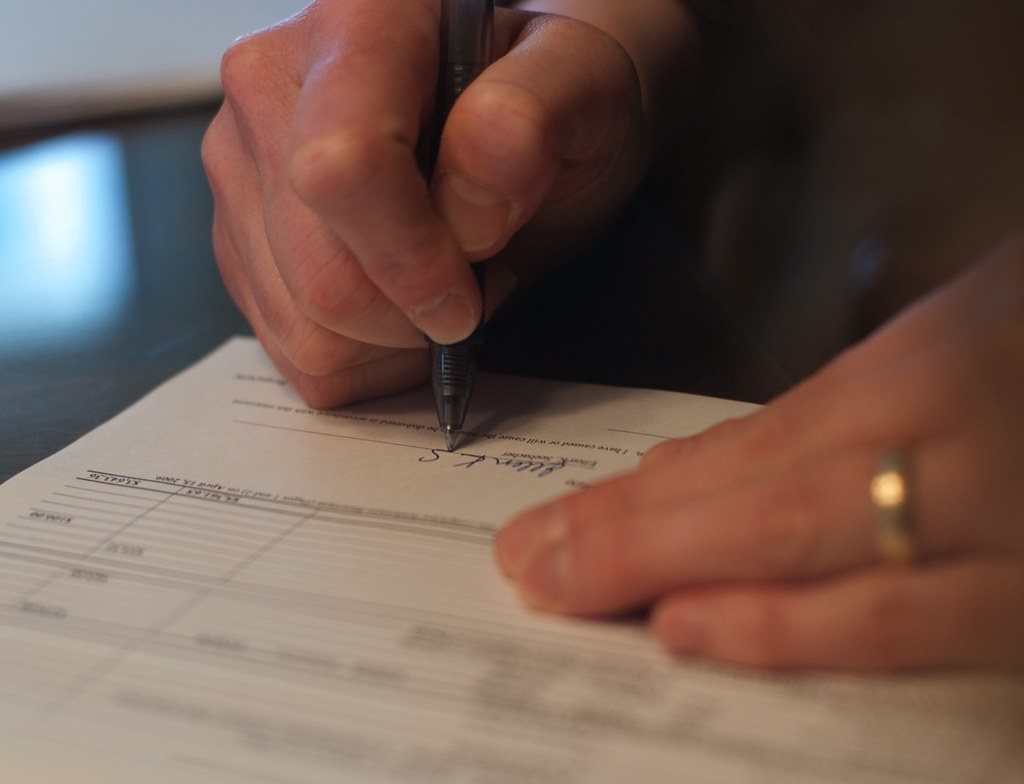
The first hearing is usually for notice. Ask for interim maintenance at that stage. Section 144 expressly allows the magistrate to order monthly maintenance for the interim period and the expenses of the proceeding while the case is pending, and the order can be made effective from the date of the application. Evidence is generally taken by affidavit and the magistrate follows a summary procedure, which is why this route usually moves faster than a contested divorce petition.
No provision in the Sanhita fixes a percentage, a formula or a ceiling. The magistrate weighs the husband's income, assets and liabilities, the wife's own income and reasonable needs, the children's expenses, the standard of living in the matrimonial home, and any other dependants he supports. In Rajnesh v. Neha, (2021) 2 SCC 324, the Supreme Court issued guidelines for these cases, including a standard affidavit of disclosure, a direction that maintenance ordinarily be awarded from the date of the application, and a direction that amounts awarded in one proceeding be adjusted against another so that the wife does not recover twice for the same period.
In negotiation, and in many courtrooms, a figure in the region of one-fifth to one-fourth of the husband's net take-home pay is used as a working starting point where the wife has no independent income. Treat that as practice, not law. There is no statutory entitlement to 25%, and a wife earning ₹60,000 a month will not be treated like one earning nothing.
Nothing prevents a wife from filing under Section 144 BNSS while a divorce petition is pending in the family court, and the reverse is equally permissible. What the law does not permit is double recovery. The Rajnesh guidelines require disclosure of every pending proceeding and every maintenance order already passed, in each forum, and direct the later court to adjust the amount already awarded. Concealing an order is the fastest way to lose an enhancement.
Priya, 34, lives in Pune with her parents and her seven-year-old son after separating from Rohit in March 2025. Rohit is a project manager with a net take-home of ₹1,45,000 a month. Priya earns ₹18,000 from part-time tuition; the child's school fee is ₹9,000 a month. Rohit files a divorce petition in the family court in September 2025. In October 2025 Priya files under Section 144 BNSS before the JMFC in Pune, where Rohit is employed, and simultaneously applies under Section 24 of the Hindu Marriage Act.
The magistrate passes an interim order of ₹35,000 a month plus ₹20,000 towards costs in December 2025. In the Section 24 application Priya discloses that order. The family court fixes ₹38,000 a month as interim maintenance and records that the amount paid under the BNSS order will be adjusted, so Rohit pays the difference and not the whole sum twice. When the magistrate passes the final order in June 2026 at ₹40,000 a month payable from October 2025, the arrears come to roughly ₹3,20,000, which the court allows to be paid in instalments. Two forums produced one coherent figure, secured partly by the family court's order and enforced by the magistrate's warrant power.
Section 144(3) gives the magistrate real teeth. If the husband fails without sufficient cause to comply, the magistrate may issue a warrant for levying the amount due in the manner provided for levying fines, and may sentence him to imprisonment for up to one month for each month's allowance left unpaid. A proviso bars the warrant unless the application is made within one year from the date the amount became due, so delay is expensive: arrears older than a year can be lost.
Keep a simple ledger of the order date, the amount, the mode of payment and the shortfall for each month. Pay nothing in cash without a written acknowledgement, and file the enforcement application when two or three months pile up rather than at the end of the year.
Marriage certificate or wedding photographs, and a written note of the date you stopped living together
His salary slips, Form 16, income tax returns, bank and credit card statements for the last three years
Your own income proof and a monthly budget showing rent, school fee, medicines and transport
The affidavit of assets and liabilities in the Rajnesh format, filed in every forum you approach
Certified copies of every order passed in any maintenance or matrimonial proceeding
A dated ledger of payments received, with mode and bank reference for each entry
Filing where neither party resides, works or last lived together is the most common error, followed by understating one's own income and then being caught by the husband's disclosure. Many wives wait for the final order before pressing for interim maintenance, which leaves a year of unpaid support unrecoverable. Accepting cash without a receipt, and letting arrears run past twelve months, both quietly destroy enforceability. Withdrawing the Section 144 case on the assumption that the family court will look after maintenance leaves a gap if that petition is adjourned or dismissed.
Next step: before you draft anything, list the district where your husband resides or works, and collect three years of his income documents. That single list decides whether the magistrate court, the family court, or both, will serve you best. This article is for general information only and is not legal advice. Consult a qualified professional for your specific facts.

By


0 Comments
No comments yet. Be the first to share your thoughts.
Leave a Comment