
About Us
We combine decades of courtroom experience with a client-first approach to deliver clear, effective legal solutions.
Please fill out the form below and we will get back to you as soon as possible.
We combine decades of courtroom experience with a client-first approach to deliver clear, effective legal solutions.
You lent ₹4,00,000 to a man you have known for years. There is no invoice, no purchase order, no GST bill, just a signed cheque that came back marked "funds insufficient". When you file a complaint under Section 138 of the Negotiable Instruments Act, 1881, the magistrate will not begin with the dishonour. The first question will be: what debt was this cheque meant to discharge? Cheque bounce without invoice proof is a routine problem for traders and individuals, and it is won or lost on paperwork assembled long before the complaint is drafted.
Section 138 is triggered only when a cheque is drawn "for the discharge, in whole or in part, of any debt or other liability". A return memo proves dishonour. It proves nothing about why the cheque was issued, and that gap is where most hand-loan complaints die.
The usual answer is Section 139, which says the court "shall presume" that the holder received the cheque for the discharge of a debt or liability. Section 118(a) adds a presumption of consideration. Read together, these provisions carry a complainant a long way. In Rangappa v. Sri Mohan, (2010) 11 SCC 441, the Supreme Court held that the Section 139 presumption extends to the existence of a legally enforceable debt, not merely to the purpose of the cheque.
But a presumption is not proof. It shifts the burden; it does not remove the complainant's obligation to place primary facts on record. The accused need not disprove the debt beyond reasonable doubt. He only has to raise a probable defence on a preponderance of probabilities, as the Supreme Court explained in Kumar Exports v. Sharma Carpets, (2009) 2 SCC 513, and reiterated in Basalingappa v. Mudibasappa, (2019) 5 SCC 418. If your complaint says only "I gave a loan and the cheque bounced", you have handed the accused an easy rebuttal.
Treat the debt as a separate case that must be proved independently. The cheque and the return memo establish the offence. Your ledger, bank records and correspondence establish the liability. Section 146 of the Act makes the bank's return memo prima facie evidence of dishonour; the text is on the Negotiable Instruments Act, 1881 page on India Code.
An invoice is convenient because it states the transaction on its face. It is not a legal requirement. "Debt or other liability" is wide enough to cover a hand loan, an advance against future supply, a running account balance, or money paid on a friend's behalf.
What a court looks for is a consistent, contemporaneous paper trail that ties the money to the cheque. In practice, the following carry the most weight, roughly in this order:
Bank records showing the money leaving your account and entering his. An RTGS advice, NEFT confirmation or UPI reference number does more than any oral testimony.
A signed acknowledgment. A receipt, a promissory note, a signed confirmation of balance, or a handwritten note. A promissory note must be properly stamped under the applicable State stamp law, so do not improvise one after the dispute begins.
Your ledger, if it was maintained in the ordinary course of business. More on this below.
Admissions in messages or email. "I will clear the 3.5 lakh after Pongal" is an acknowledgment of liability, and it also helps on limitation.
Subsequent conduct. Part payments, interest credited, or a second cheque issued towards the same balance.
Witnesses to the handover, especially for cash. An employee, accountant or family member who was present, and who is named in the complaint, is better than a witness produced at the trial stage.
Keep the originals. Screenshots of chats should be backed by the device and, where the chat is contested, by a certificate for electronic records.
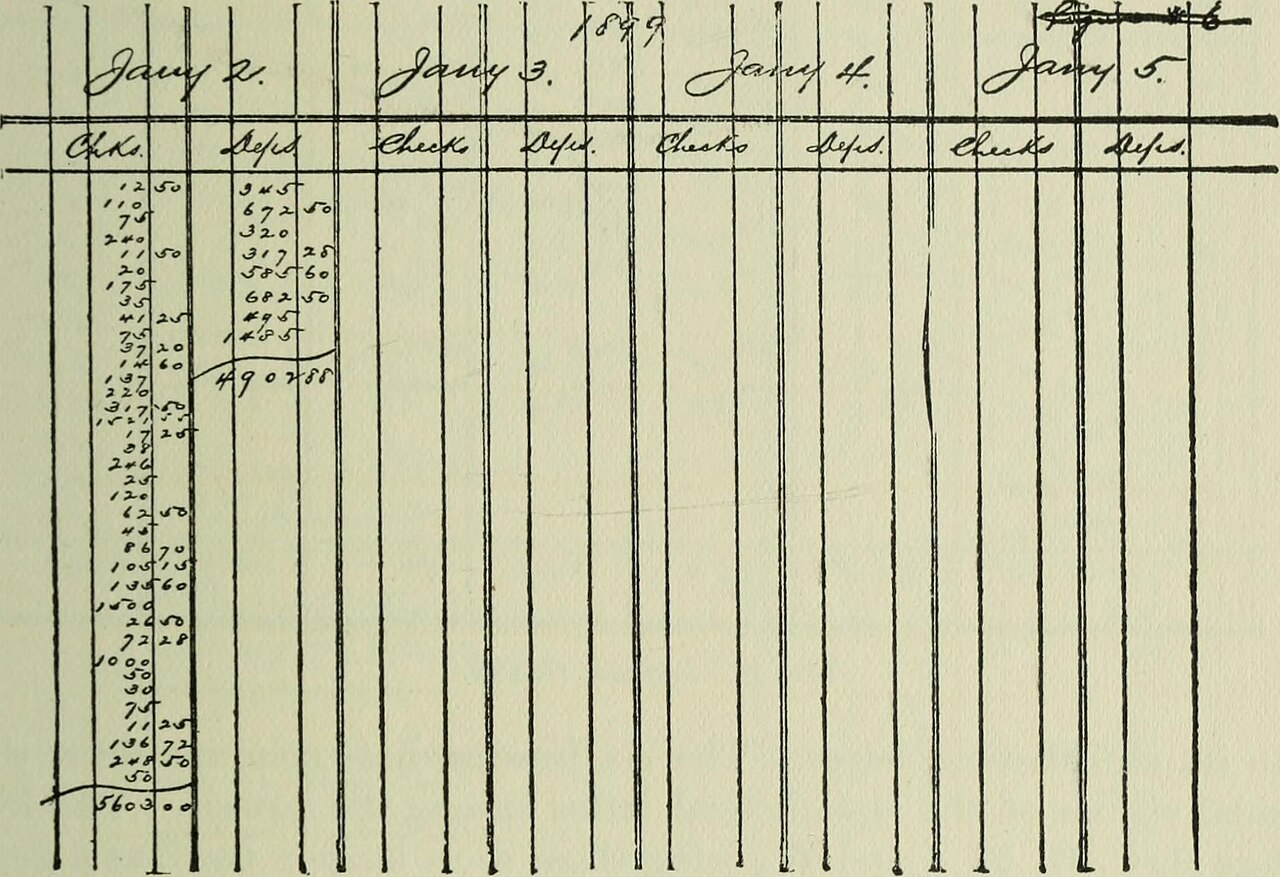
Entries in books of account regularly kept in the course of business are relevant, and Section 34 of the Bharatiya Sakshya Adhiniyam, 2023 (earlier Section 34 of the Indian Evidence Act, 1872) recognises them in electronic form as well. Two conditions decide whether a ledger helps or hurts.
First, it must be contemporaneous. A ledger page written out after the cheque bounced, in handwriting that matches nothing else in the file, invites exactly the cross-examination you want to avoid.
Second, it must reconcile. It should show the opening balance, each advance with its date and mode, each repayment, and the closing balance, and every non-cash entry should match a bank entry. If your ledger shows a ₹3,50,000 credit to the borrower's account but your bank statement shows ₹2,50,000, the discrepancy becomes the defence's case.
Produce the extract with the person who maintains the books, and produce the books themselves for inspection. An extract certified by you alone, with no supporting vouchers, is weak.
For your own account, a statement stamped by the branch is normally enough. For the accused's account, or where the defence disputes the statement, use the Bankers' Books Evidence Act, 1891. Section 2(3) defines "bankers' books" to include ledgers, day books, cash books, account books and other records used in the ordinary course of the bank's business. Section 4 makes a certified copy of an entry admissible as prima facie evidence of the entry and of the matters recorded.
Ask the branch in writing for a certified copy under the Bankers' Books Evidence Act, signed by the branch manager or another authorised officer, with the bank's seal and the certificate language. A plain printout with a rubber stamp is routinely challenged.
If the bank does not respond, apply to the magistrate for summons to produce the record. The corresponding provision is Section 94 of the Bharatiya Nagarik Suraksha Sanhita, 2023, which replaces Section 91 of the Code of Criminal Procedure, 1973. Do this early. Banks take weeks.
Cash advances are lawful, but they attract a predictable set of questions. Where did the cash come from, when exactly was it handed over, who counted it, and why was it not routed through the bank?
There is also a tax provision the defence will raise. Section 269SS of the Income Tax Act, 1961 prohibits accepting a loan or other specified sum of ₹20,000 or more otherwise than by account payee cheque, bank draft or electronic mode. Breach attracts a penalty under Section 271D equal to the amount. The penalty falls on the borrower who accepted the cash, and a breach does not by itself extinguish the liability. Expect the argument anyway, and be ready with your source of funds. The provisions are published on incometaxindia.gov.in.
Repayment in cash of ₹20,000 or more is separately restricted by Section 269T, which matters when the borrower claims he already paid you back.
Ramesh runs a cloth wholesale shop in Tiruppur. Between June and September 2024 he advances ₹3,50,000 to Suresh, a job-work contractor: ₹2,00,000 by RTGS on 12 June, ₹1,00,000 by UPI on 3 August, and ₹50,000 in cash from shop collections on 9 September. There is no invoice, because no goods were sold. Suresh hands over a cheque for ₹3,50,000 dated 15 March 2025. It is deposited on 18 March and returned on 20 March 2025 for insufficient funds.
Ramesh's file should contain the RTGS advice and the bank statement showing the 12 June debit; the UPI transaction reference from his bank statement; a cash receipt signed by Suresh on 9 September, or failing that, the cash book entry and the name of the employee who counted the notes; his ledger folio for Suresh showing all three advances and no repayments; a December 2024 message in which Suresh writes that he will settle the account after Pongal; and the bank's certified statement under the Bankers' Books Evidence Act.
The timelines then run on their own arithmetic. The statutory demand notice must be issued within 30 days of the return memo, that is by 19 April 2025. Suresh gets 15 days from receipt to pay. If he does not, the complaint must be filed within one month of the cause of action.
The ₹50,000 cash tranche is the weak link, and it is a small one. If Ramesh can show the cash book, the shop's collection pattern, and a receipt signed at the time, that tranche survives. If the only evidence is his oral word three years later, the defence will ask the court to disbelieve the entire ₹3,50,000 rather than just the cash portion.
Your examination-in-chief is usually an affidavit under Section 145 of the NI Act. That affidavit must state the debt in specifics: date, mode, amount, purpose, and the balance outstanding. "The accused borrowed money and issued a cheque" is not a pleading. It is a placeholder, and it will be picked apart.
Expect these lines of attack:
One point of discipline: keep the loan account separate from any trade account with the same person. Mixing them lets the defence argue that the cheque related to a disputed supply rather than the hand loan.
Bank statement and transfer advices for every non-cash advance, in date order
Signed receipt, promissory note or confirmation of balance for the loan
Ledger extract for the borrower's account, reconciled with the bank entries
Certified copy of bank records under the Bankers' Books Evidence Act where the account is not yours
Original cheque, bank return memo and the statutory demand notice with postal proof
Messages, email or written admissions acknowledging the balance
Names and addresses of witnesses to the handover, particularly for cash
The costliest error is waiting. The 30-day window for the demand notice runs from the date the bank returns the cheque, and it is not extendable by agreement. The second is filing a complaint that describes the loan in one line and then producing a ledger for the first time in evidence. The third is relying on a ledger that does not match the bank statement. Each of these gives the accused a plausible defence without his having to prove anything.
If you are holding a bounced cheque for a hand loan today, write down the debt chronologically, date by date and mode by mode, and then match every line against a bank record or a signed document. Where a line has no support, arrange for the witness or the record now, before the complaint is filed. Judgments of the Supreme Court on Section 138 are available at main.sci.gov.in.
This article is for general information only and is not legal advice. Consult a qualified professional for your specific facts.

By


0 Comments
No comments yet. Be the first to share your thoughts.
Leave a Comment